Last updated: November 2026
Pet insurance for English Springer Spaniels
The English Springer Spaniel is a friendly, eager, tireless Sporting dog from England, recognized by the Kennel Club there in 1902 and by the American Kennel Club in 1910. The AKC standard puts the breed at 19 to 20 inches and 40 to 50 pounds, with dogs at about 20 inches and 50 pounds and bitches at about 19 inches and 40 pounds. Springers come in two real forms, field-bred and show-bred, two gene pools the sources describe as almost completely separate for at least 70 years, and a family should know which one is coming home. How long a Springer lives depends on how you count it, and this guide keeps the published methods separate: the AKC lists life expectancy at 12 to 14 years, a UK life-table study put life expectancy at birth at 11.9 years, and a 2024 UK study of over half a million dogs found a median lifespan of 13.5 years. This is, at heart, a healthy, happy breed. Its real planning list is ears first, then two screened joints, a set of DNA-tested conditions a good breeder checks for, and a liver risk most owners have never heard of, and every one of those rewards planning early, while your Springer is still a puppy at home.
Enroll as a puppy, before any ear infection, eye finding or joint note exists in your Springer's record. In this breed the first ear note can arrive in the first year, and a finding recorded before enrollment follows the dog for good.
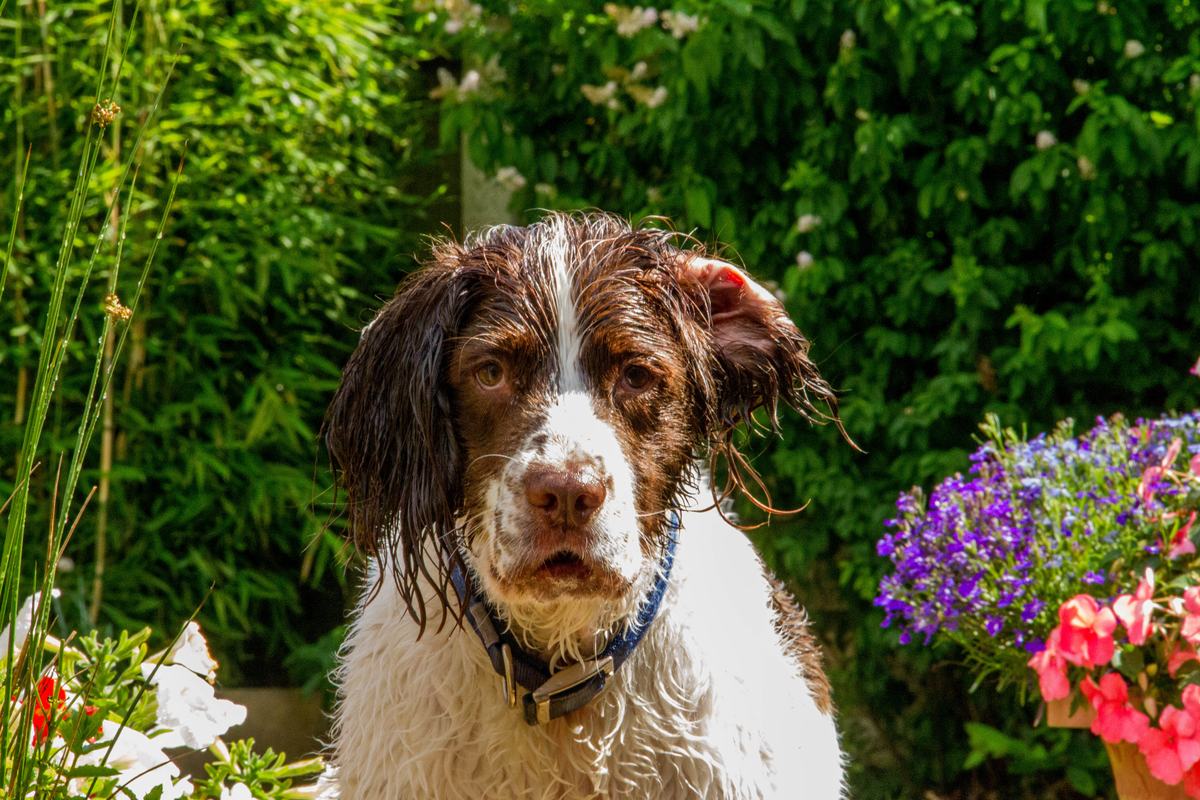
Cost figures are typical ranges, not quotes or guarantees. Your premium depends on your springer's age, your zip code, and the deductible and reimbursement level you choose.
Common health issues in English Springer Spaniels
Ear infections (otitis externa)
Risk level: Common / expensive
Ear trouble is this breed's signature problem, and the shape of the ear explains it: the long, close-hanging ear flap keeps air from circulating in the ear canal, so the canal stays warm and damp and infection follows. In a Finnish primary-care study of 98,736 dogs seen at 55 clinics in 2010, 19.6% of English Springer Spaniels had otitis externa recorded (96 of 491 Springers; 95% CI 16.1 to 23.1), among the highest rates of the breeds studied. The breed's own club, the English Springer Spaniel Field Trial Association, names ear infections as common in the breed for exactly that anatomical reason, and UK VetCompass primary-care data put the one-year prevalence across all dogs at 7.3%, with pendulous ear carriage carrying 1.76 times the odds of erect ears. The honest owner point is simple: ear checks and careful drying after swimming are this breed's cheapest care habit, because most ear care is years of cleaning, drops, and repeat vet visits, and the first infection can arrive in the first year of life.
Hip dysplasia
Risk level: Common
Hips are screened in this breed, and two registries on two continents tell a consistent story. In the US Orthopedic Foundation for Animals registry, 12.4% of 20,585 evaluated Springers were graded dysplastic. In Swedish screening data, 235 of 1,943 screened Springers (12.1%) received hip grades of C, D or E. Both figures describe screened, mostly breeding, populations, not a lifetime risk for every pet Springer, and that label matters. What the convergence does tell you is that hip screening is not a formality in this breed. Ask for both parents' hip results and check them in the OFA database. When a hip does fail badly enough for surgery, the site-standard cost anchor applies: in a 2024 survey of 14 US hospitals published in the Journal of the American Veterinary Medical Association, a total hip replacement averaged $7,064, with a range of $4,500 to $12,000, printed here as general dog data, not a Springer figure.
Elbow dysplasia
Risk level: Common
Elbows are the screening surprise in this breed, grading worse than hips in the largest registry. In the OFA elbow registry, 16.0% of 5,917 evaluated Springers were graded abnormal (Grade I 13.0%, Grade II 2.6%, Grade III 0.4%). Swedish screening of a smaller, differently graded population found 28 of 360 Springers (7.8%) with abnormal elbow grades. The two figures are printed side by side with their labels, never merged, because the schemes grade differently. UK VetCompass data support the concern from another angle, giving the breed 2.26 times the odds of elbow joint disease of crossbred dogs (95% CI 1.43 to 3.59). The UK Kennel Club's health commentary notes that working lines screen worse than show lines, which is one more reason to ask which kind of Springer a breeder breeds, and to see both parents' elbow results before a puppy comes home.
PRA and eye disease
Risk level: Common
Progressive retinal atrophy in this breed is mostly the cord1 form, also called crd4, an autosomal recessive condition caused by a variant in the RPGRIP1 gene, and it has a DNA test. The Kennel Club's DNA scheme data show 18,902 English Springers tested for cord1 PRA, of whom 507 were carriers and just 26 were affected, and in a further set of 925 UK Springers none carried two copies of the MAP9 modifier associated with early-onset disease, so cord1-affected Springers typically develop signs late, or not at all. The breed club recommends an annual eye examination by a board-certified ophthalmologist for breeding stock, because the UK eye scheme also screens for generalized PRA, which usually appears after age 5, retinal pigment epithelial dystrophy, and goniodysgenesis, a drainage-angle problem linked to glaucoma risk. Ask for both parents' DNA results and current eye exam results: in this breed, the paperwork can genuinely tell you where your puppy stands.
Chronic hepatitis
Risk level: Less common
Most Springer owners have never heard of this one, and it belongs in every Springer family's file. The breed is predisposed to a form of chronic hepatitis, a long-running liver inflammation, that tends to be more severe than the typical form, affects younger dogs, and is seen more often in females. In a UK case-control study of 66 Springer cases and 84 controls (Bexfield et al., 2012), a DLA class II immune-system haplotype carried 3.1 times the odds of the disease, and two further UK studies report the breed at increased chronic hepatitis risk. No trustworthy prevalence percentage exists, so this page prints none. The practical point is vigilance rather than worry: persistently raised liver enzymes in a Springer deserve follow-through, not watchful forgetting, and a vet who knows the breed's liver story will treat those numbers accordingly.
What does pet insurance cost for an English Springer Spaniel?
Start from the $62.44/month national dog average (NAPHIA, 2024 data) as an estimate only; there is no trustworthy English Springer Spaniel specific price to quote here. The money question for this breed is rarely one dramatic bill. It is years of ear care for a dog whose ears were built to trap moisture, a real orthopedic screening story in both hips and elbows if a joint ever needs surgery, and senior watchfulness for eyes and liver across a long life, with a median of 13.5 years in the largest UK study. Two listed concerns stay honestly thin on this page: hereditary epilepsy is described by the breed club as relatively rare, with a familial pattern in some lines and onset usually before age 5, and no peer-reviewed breed prevalence exists, so we print none; skin problems such as seborrhea and allergic skin disease are management issues the breed club and dermatology references name, again with no verified prevalence. Plan for the ears, the joints, and the long senior years, and keep the breeder's test results for all of them.
For context, the national average premium for dogs is roughly $62/month - but breed, age, and location move that number a lot. Estimate your premium with our cost calculator, or see the bigger picture in our lifetime cost projector, which compares a common emergency bill with and without coverage.
Two more DNA tests belong in every Springer buyer's file. PFK deficiency is an autosomal recessive muscle and red-cell energy disorder with a DNA test offered by PennGen, the University of Missouri and Laboklin; the breed club notes that careful breeding has largely eliminated it from tested lines, and it is much more commonly found in American-bred than UK-bred Springers, so no prevalence figure is printed here. Fucosidosis is a progressive, fatal lysosomal storage disease with onset at 18 months to 4 years and a DNA test available since 1997; in Kennel Club scheme data, 21 carriers were found among 21,087 Springers tested clear or hereditarily clear, and the last tested carrier in show-bred lines was found in 2013. Together with the CHIC program's five items for this breed, confirmed on the OFA CHIC page at build time: hip evaluation, elbow evaluation, eye examination, the cord1 PRA DNA test, and a DNA repository sample, they make this breed's breeder conversation unusually complete.
Spaniel ears are a shared conversation on this site. Our Cocker Spaniel insurance guide covers the Springer's closest spaniel peer, whose ear and eye story is told with its own figures, kept strictly separate from the ones above. Our Labrador Retriever insurance guide covers a fellow Sporting breed whose joint and weight story rewards the same early planning.
What to look for in a policy for an English Springer Spaniel
- Enroll as a puppy, before any ear infection, eye finding or joint note exists in your Springer's record. In this breed the first ear note can arrive in the first year, and a finding recorded before enrollment follows the dog for good.
- Confirm that hereditary conditions are covered, not excluded. Ears follow this breed's anatomy, and its eyes, joints and liver are its inherited core, so a policy that carves out hereditary conditions carves out the Springer.
- Ask any breeder for both parents' CHIC results, hip and elbow evaluations, an eye examination, and the cord1 PRA DNA test, plus PFK and fucosidosis DNA results, which the breed club recommends in addition to CHIC. Check the actual results in the OFA database, because a CHIC number means the tests were done and the results are public, not that the dog passed.
- Keep up the ear routine, regular checks and careful drying after swimming. It is the cheapest care habit in this breed, and it protects the part of your Springer most likely to need the vet.
- Keep the deductible at a level you can pay on a hard day without hesitation - the policy only protects your dog if you can afford to use it.
Compare insurers for your springer
Typical plan options from major insurers:
| Insurer | Reimbursement | Annual limit | Waiting periods | Standout feature | Quote |
|---|---|---|---|---|---|
| Spot | 70%, 80% or 90% | $2,500 - unlimited | 14 days (accident & illness) | Preventive-care add-on available. | Get a quote |
| Trupanion | 90% | Unlimited payouts (no annual cap) | 5 days (injury) / 30 days (illness) | Per-condition lifetime deductible; direct vet payment option. | Get a quote |
| Embrace | 70%, 80% or 90% | $5,000 - $30,000 | No wait (accident) / 14 days (illness) / 6 mo (orthopedic, varies by state) | Deductible shrinks $50 each claim-free year. | Get a quote |
| Pets Best | 70%, 80% or 90% | $5,000 or unlimited | 3 days (accident) / 14 days (illness) / 6 mo (cruciate) | Wellness add-on; short accident waiting period. | Get a quote |
| Lemonade | 70%, 80% or 90% | $5,000 - $100,000 | No wait (accident, most states) / 14 days (illness) / 30 days (orthopedic) / 6 mo (cruciate) | Preventive packages; not offered in every state. | Get a quote |
| ASPCA Pet Health Insurance | 70%, 80% or 90% | Multiple annual-limit options | 14 days (accident & illness) | Preventive-care add-on available. | Get a quote |
| Figo | 70%, 80%, 90% or 100% | Up to unlimited annual max | 1 day (accident) / 14 days (illness) / 6 mo (orthopedic) | One of the few with a 100% reimbursement option. | Get a quote |
| Fetch | 70%, 80% or 90% | $5,000 - unlimited | No wait (accident) / 15 days (illness) / 6 mo (orthopedic) | Covers sick-visit exam fees. | Get a quote |
Plan options shown are typical ranges widely published by each insurer; details change and vary by state. Always confirm current terms on the insurer's website before enrolling. Quote buttons link directly to each insurer's website. We don't earn a commission on these links yet.
Other breed guides
- French Bulldog
- Labrador Retriever
- Golden Retriever
- German Shepherd
- Goldendoodle
- Dachshund
- Rottweiler
- Bulldog
- Cavalier King Charles Spaniel
- Shih Tzu
- Boxer
- Australian Shepherd
- German Shorthaired Pointer
- Pembroke Welsh Corgi
- Bernese Mountain Dog
- Border Collie
- Miniature Schnauzer
- Cocker Spaniel
- Yorkshire Terrier
- Great Dane
- Chihuahua
- Pug
- Havanese
- Boston Terrier
- Doberman Pinscher
- Vizsla
- Australian Cattle Dog
- Shetland Sheepdog
- Belgian Malinois
- Rhodesian Ridgeback
- Bichon Frise
- Siberian Husky
- Cane Corso
- Dalmatian
- Chow Chow
- Akita
- Alaskan Malamute
Frequently asked questions
Is pet insurance worth it for an English Springer Spaniel?
For most English Springer Spaniel owners, yes - this is a breed where one major surgery can cost more than years of premiums. The math favors insurance most when the breed's common conditions are expensive, which is the case here.
When should I insure my English Springer Spaniel?
As early as possible - ideally as a puppy. Conditions diagnosed before enrollment are excluded as pre-existing, and this breed's predispositions mean waiting is the expensive mistake.
What is the best pet insurance for English Springer Spaniels?
There is no single best insurer for every dog - the right pick depends on your budget, your dog's age, and which conditions worry you most. Compare annual limits, orthopedic waiting periods, and reimbursement rates across the table above, then run real quotes. (BreedCover may earn a commission if you buy through our links.)