Last updated: November 2026
Pet insurance for Australian Cattle Dogs
Tough, tireless, and famously loyal: a blue or red heeler built in Australia for long days behind cattle, recognized by the AKC in 1980 and a charter member of the Herding Group. Males stand 18 to 20 inches and females 17 to 19 inches, at 35 to 50 pounds (AKC). How long an Australian Cattle Dog lives depends on how you count it, and this guide keeps the two published methods separate: the AKC lists life expectancy at 12 to 16 years, and a large UK study of 584,734 dogs put the breed's median lifespan at 14.0 years, a figure that rests on a small sample of about 50 recorded deaths, so treat it as encouraging rather than exact. This is a genuinely hardy dog, and the honest planning list is shorter than most: hips and elbows that are screened for a reason, a roughly one in nine chance of deafness in one or both ears that only a hearing test can find, and inherited eye diseases with DNA tests. Enrolling before any of it is written down is the whole game.
Enroll as a puppy, before the first limp, eye finding, or hearing note exists. In this breed the conditions that cost real money are inherited, and a hip score, an eye exam finding, or a BAER result recorded before enrollment follows the dog for good.
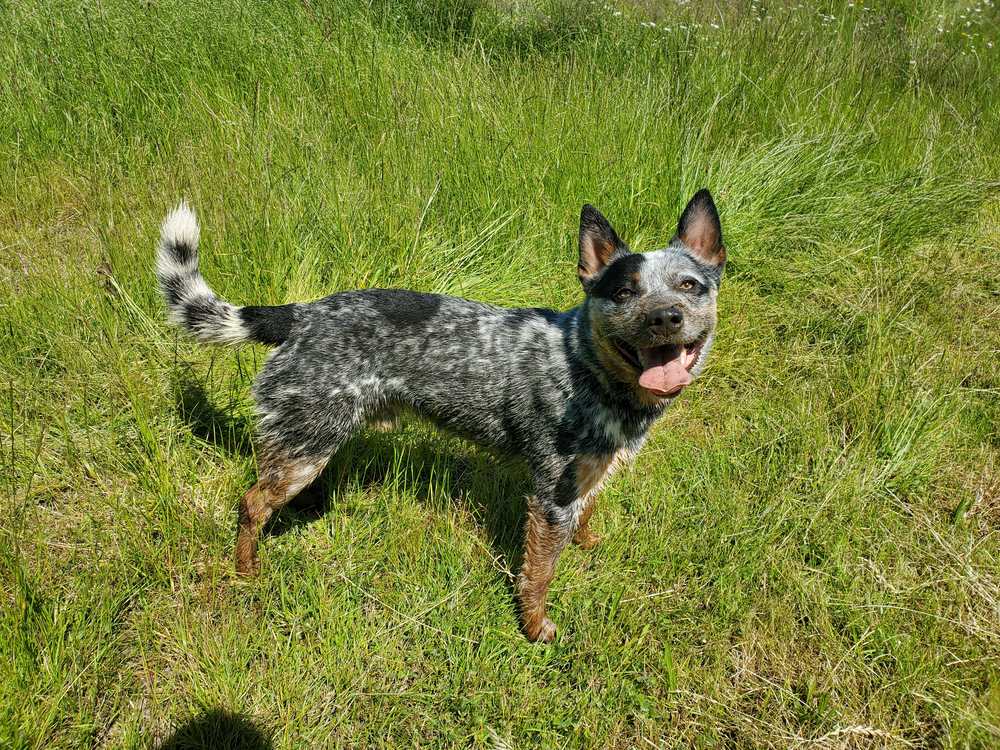
Cost figures are typical ranges, not quotes or guarantees. Your premium depends on your blue heeler's age, your zip code, and the deductible and reimbursement level you choose.
Common health issues in Australian Cattle Dogs
Hip dysplasia
Risk level: Common / expensive
Hips come first in this breed, not because the breed is fragile, but because the risk is real enough that the breed's own health program tests breeding dogs for it. The breed's CHIC requirements include a hip evaluation at 2 years or older, by OFA or PennHIP, and a breeder who cannot show you both parents' hip results is telling you something. In the UK BVA and Kennel Club hip scheme, the breed's median total hip score is 11 across a small tested population (138 dogs tested in 15 years in the scheme's 2024 statistics); that is a scheme score from dogs breeders chose to test, not a share of the breed affected. The only registry percentage verified for this page is a historical one, printed with its label: in an OFA table covering evaluations from January 1974 to January 1996, 14.2% of 959 Australian Cattle Dog evaluations were rated dysplastic, in a voluntarily submitted, breeder screened population, so it is not a current figure and not your puppy's risk. When a hip does fail, the bills are the serious kind: in a 2024 JAVMA survey of 14 US hospitals, total hip replacement in dogs averaged $7,064 (range $4,500 to $12,000), and femoral head and neck excision averaged $3,347 (range $1,800 to $5,700). Those are general dog surgery survey prices, not breed specific figures, and they are exactly the size of bill a policy exists for.
Congenital deafness
Risk level: Common
About 1 in 9 Australian Cattle Dogs is deaf in one or both ears, and the breed's dataset here is the strongest on this page. In an Australian study (Sommerlad et al., 2012), 899 Australian Cattle Dogs were BAER hearing tested at the University of Queensland between 1996 and 2008: 10.8% were deaf in one or both ears, made up of 7.5% deaf in one ear and 3.3% deaf in both, and among puppies from completely tested litters the figure was 11.1%. A UK study (Marsh et al., 2021) of 524 puppies BAER tested at 4 to 10 weeks found the same shape: 11.4% with some deafness, 9.7% in one ear and 1.7% in both, with 88.6% hearing normally in both ears. The catch is that a dog deaf in one ear behaves almost normally, so deafness in one ear is difficult to detect without the BAER test, which is why BAER testing of breeding dogs and puppies is a required screen for this breed. Be honest with yourself about what the test buys: a follow-up study (Sommerlad et al., 2014) found that 10 years of BAER screening produced no substantial reduction in prevalence, even in litters where both parents tested normal, so screening is information, not a guarantee. There is no treatment; a deaf dog is managed with training and safety habits for life, and a puppy deaf in both ears changes a home's plans, which is exactly why the breeder's test results matter before you fall for a puppy.
Progressive retinal atrophy: two forms, two tests
Risk level: Common
This breed carries two separate inherited forms of progressive retinal atrophy, a painless, incurable blinding disease, and each has its own DNA test. The prcd form is the required screen: the breed's CHIC program requires a prcd-PRA DNA test from an approved laboratory. In an Italian study of dogs DNA tested between 2010 and 2021 (Ghilardi et al., 2023), of 59 Australian Cattle Dogs tested for the prcd gene, 62.7% were clear, 33.9% were carriers of one copy, and 3.4% were affected or at risk; that is a share of a tested sample, not a breed wide prevalence. The condition is autosomal recessive, so a puppy needs two copies to be affected, and blindness can begin as young as 3 years, with typical diagnosis at 4 to 6 years. The second form, rcd4, is a separate later onset disease, with signs at 5 to 12 years and average onset at 10 years, on the AKC's breed club list as an optional but recommended test. The honest point for a buyer: a clear prcd result does not clear rcd4, because they are different genes. No treatment exists for either form, so the breeder's two test results are the protection.
Primary lens luxation
Risk level: Common
A dislocated lens is this breed's eye emergency. The ADAMTS17 mutation that causes primary lens luxation was found in clinically affected dogs of this breed (Gould et al., 2011), and a DNA test for it sits on the AKC's current breed club recommended test list for the Australian Cattle Dog. When a lens slips, it is painful and can blind the eye, and it is a same-day vet emergency, not a wait-and-see. No Australian Cattle Dog specific prevalence was verified for this page, so none is printed; the cross breed carrier figures on laboratory pages describe many breeds at once and are not this breed's numbers. Emergency eye care and possible lens surgery run into the thousands, printed here as a range of scale, not a survey figure, and a breeder who tests for the mutation is reducing a risk you cannot see in a puppy.
Elbow dysplasia
Risk level: Common
Elbows are the second joint on the screening list: an elbow evaluation is a required screen in the breed's CHIC program, alongside hips. In the UK BVA elbow scheme, of 182 Australian Cattle Dogs graded since 1999, 19% carried grade 1 or above; that is a screened population of dogs breeders chose to submit, printed with its label, not a share of all pets. Most graded dogs, 81% in that scheme, were grade 0. Sore elbows show up as front leg stiffness after rest and a dog who shortens his stride on hard ground, and extra weight makes sore joints worse, so a working dog's condition is part of the care. No elbow surgery cost was verified for this page, so costs here stay qualitative: imaging, long-term joint care, and surgery in the serious minority are the shape of the risk.
What does pet insurance cost for an Australian Cattle Dog?
Start from the $62.44/month national dog average (NAPHIA, 2024 data) as an estimate only; there is no trustworthy Australian Cattle Dog specific price to quote here. The value of a policy concentrates in one possible joint surgery (a hip replacement averaged $7,064 in a 2024 survey of US hospitals), an eye emergency, and the slow, untreatable vision loss that only a breeder's DNA tests can head off. This is a hardy, long lived working breed priced near the dog average, and the labeled study lifespan on this page means more premium years and more senior years than most herding breeds. Asking for both parents' full test results (OFA or PennHIP hips, OFA elbows, a current eye exam, prcd-PRA DNA, BAER hearing, and the primary lens luxation DNA test on the AKC's current list), and checking the actual results in the OFA database, is the single most useful buyer action this page can teach, because a CHIC number means the tests were done and the results are public, not that the dog passed.
For context, the national average premium for dogs is roughly $62/month - but breed, age, and location move that number a lot. Estimate your premium with our cost calculator, or see the bigger picture in our lifetime cost projector, which compares a common emergency bill with and without coverage.
Herding work shapes this breed's screening story, and its closest working peer on this site shares much of it. Our Border Collie insurance guide covers another tireless herding breed whose owners ask many of the same hip, eye, and hearing questions.
Our Belgian Malinois insurance guide covers a third tireless herder, the Belgian working breed whose screened joint rates are genuinely low and whose planning list starts with eyes.
What to look for in a policy for an Australian Cattle Dog
- Enroll as a puppy, before the first limp, eye finding, or hearing note exists. In this breed the conditions that cost real money are inherited, and a hip score, an eye exam finding, or a BAER result recorded before enrollment follows the dog for good.
- Confirm that hereditary conditions are covered, because hips, elbows, eyes, and hearing are this breed's inherited core.
- Ask for both parents' full test results (OFA or PennHIP hips, OFA elbows, a current eye exam, prcd-PRA DNA, BAER hearing, and the primary lens luxation DNA test on the AKC's current list), and check the actual results in the OFA database, because a CHIC number alone is not a pass.
- Choose an annual limit that could carry one joint or eye surgery in a bad year, because the expensive version of this breed's story is a single large bill, not many small ones.
- Keep the deductible at a level you can pay on a hard day without hesitation - the policy only protects your dog if you can afford to use it.
Compare insurers for your blue heeler
Typical plan options from major insurers:
| Insurer | Reimbursement | Annual limit | Waiting periods | Standout feature | Quote |
|---|---|---|---|---|---|
| Spot | 70%, 80% or 90% | $2,500 - unlimited | 14 days (accident & illness) | Preventive-care add-on available. | Get a quote |
| Trupanion | 90% | Unlimited payouts (no annual cap) | 5 days (injury) / 30 days (illness) | Per-condition lifetime deductible; direct vet payment option. | Get a quote |
| Embrace | 70%, 80% or 90% | $5,000 - $30,000 | No wait (accident) / 14 days (illness) / 6 mo (orthopedic, varies by state) | Deductible shrinks $50 each claim-free year. | Get a quote |
| Pets Best | 70%, 80% or 90% | $5,000 or unlimited | 3 days (accident) / 14 days (illness) / 6 mo (cruciate) | Wellness add-on; short accident waiting period. | Get a quote |
| Lemonade | 70%, 80% or 90% | $5,000 - $100,000 | No wait (accident, most states) / 14 days (illness) / 30 days (orthopedic) / 6 mo (cruciate) | Preventive packages; not offered in every state. | Get a quote |
| ASPCA Pet Health Insurance | 70%, 80% or 90% | Multiple annual-limit options | 14 days (accident & illness) | Preventive-care add-on available. | Get a quote |
| Figo | 70%, 80%, 90% or 100% | Up to unlimited annual max | 1 day (accident) / 14 days (illness) / 6 mo (orthopedic) | One of the few with a 100% reimbursement option. | Get a quote |
| Fetch | 70%, 80% or 90% | $5,000 - unlimited | No wait (accident) / 15 days (illness) / 6 mo (orthopedic) | Covers sick-visit exam fees. | Get a quote |
Plan options shown are typical ranges widely published by each insurer; details change and vary by state. Always confirm current terms on the insurer's website before enrolling. Quote buttons link directly to each insurer's website. We don't earn a commission on these links yet.
Other breed guides
- French Bulldog
- Labrador Retriever
- Golden Retriever
- German Shepherd
- Goldendoodle
- Dachshund
- Rottweiler
- Bulldog
- Cavalier King Charles Spaniel
- Shih Tzu
- Boxer
- Australian Shepherd
- German Shorthaired Pointer
- Pembroke Welsh Corgi
- Bernese Mountain Dog
- Border Collie
- Miniature Schnauzer
- Cocker Spaniel
- Yorkshire Terrier
- Great Dane
- Chihuahua
- Pug
- Havanese
- Boston Terrier
- Doberman Pinscher
- Vizsla
- Shetland Sheepdog
- English Springer Spaniel
- Belgian Malinois
- Rhodesian Ridgeback
- Bichon Frise
- Siberian Husky
- Cane Corso
- Dalmatian
- Chow Chow
- Akita
- Alaskan Malamute
Frequently asked questions
Is pet insurance worth it for an Australian Cattle Dog?
For most Australian Cattle Dog owners, yes - this is a breed where one major surgery can cost more than years of premiums. The math favors insurance most when the breed's common conditions are expensive, which is the case here.
When should I insure my Australian Cattle Dog?
As early as possible - ideally as a puppy. Conditions diagnosed before enrollment are excluded as pre-existing, and this breed's predispositions mean waiting is the expensive mistake.
What is the best pet insurance for Australian Cattle Dogs?
There is no single best insurer for every dog - the right pick depends on your budget, your dog's age, and which conditions worry you most. Compare annual limits, orthopedic waiting periods, and reimbursement rates across the table above, then run real quotes. (BreedCover may earn a commission if you buy through our links.)