Last updated: November 2026
Pet insurance for Sphynx cats
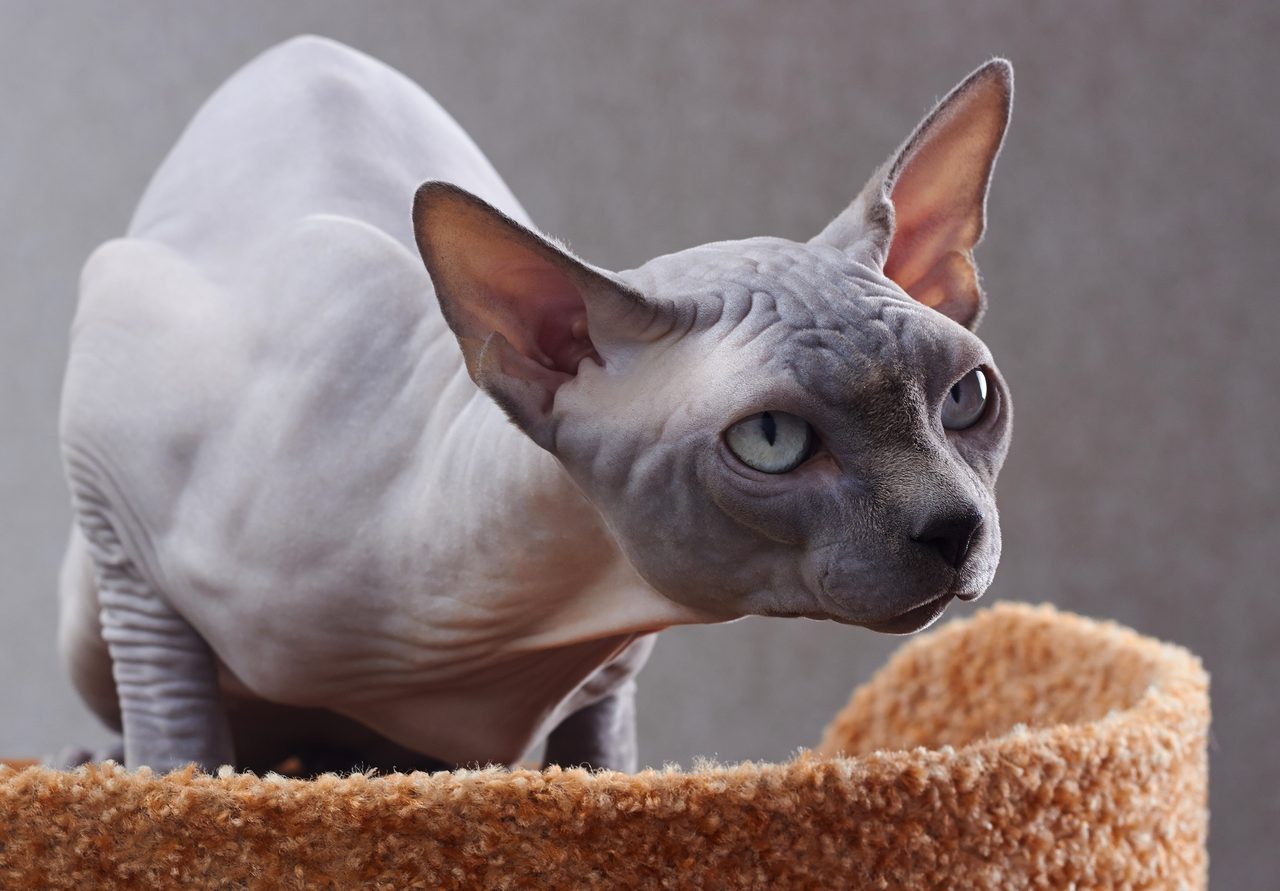
A warm, wrinkled, people-focused companion - medium sized and muscular in the Cat Fanciers' Association (CFA) and The International Cat Association (TICA) breed descriptions, heavier than she looks, at a published typical weight of 6 to 12 pounds (Petco and Litter-Robot breed profiles), and not truly hairless at all: a fine down, often compared to suede, can cover the body, and the breed still makes the Fel d 1 protein found in cat skin and saliva, so a Sphynx is not hypoallergenic. Individual Sphynx cats can live well into their teens, but the one peer-reviewed life table is sobering: life expectancy at birth of 6.7 years (95% CI 4.5 to 8.8), from a small sample of 18 Sphynx deaths, the shortest of the 12 breeds studied, against 11.7 years for UK companion cats overall (Teng et al., 2024). A life-expectancy-at-birth figure is pulled down by early deaths in the records and is not a prediction for an individual well-cared-for cat - which is exactly why the heart screening below matters so much in this breed.
Enroll as a kitten, before any heart murmur or ultrasound finding is in the records - in this breed the screening habit is the care plan, and a finding recorded before enrollment can become a pre-existing exclusion.
Cost figures are typical ranges, not quotes or guarantees. Your premium depends on your cat's age, your zip code, and the deductible and reimbursement level you choose.
Common health issues in Sphynx cats
Heart disease (hypertrophic cardiomyopathy, HCM)
Risk level: Common / expensive
In a French echocardiographic screening study of 114 Sphynx cats presented for cardiovascular screening (Chetboul et al., 2012), 23 cats (20.2%) had hypertrophic cardiomyopathy and 16 cats (14.0%) had congenital heart disease, most often mitral valve dysplasia, and HCM became significantly more common with age. In a separate New Zealand screening study of 55 apparently healthy adult Sphynx cats from registered breeders and pet owners (Seo et al.), 40.0% had HCM at a median age of 5.8 years, and 3 affected cats died of congestive heart failure during the study. Those are two different screening groups at different ages, printed separately on purpose, never as one merged rate. The shared point is what matters: heart disease is common in this breed and it can develop and progress with age, so screening is a repeat echocardiogram habit, not a one-time kitten check. A referral echocardiogram typically costs $300 to $800 in published US cost guides.
The heart gene test, honestly explained
Risk level: Common
A DNA test for one reported heart gene exists, and it deserves an honest explanation. A variant in the ALMS1 gene was reported as associated with HCM in Sphynx cats (Meurs et al., 2021), and tests for the variant are marketed to breeders and owners. In later studies of screened cats, though, the gene result did not predict which cats actually had heart disease on ultrasound: in the New Zealand screening study above, 70.9% of the 55 cats carried at least one copy of the variant, yet carrying it was not associated with an HCM diagnosis, a result the authors note is consistent with a European and American study that also found no association, and a Thai study of 47 Sphynx cats, in which 44.7% carried the variant, again found no significant association with echocardiographic HCM features. So a clear ALMS1 result is not a cleared heart, and a positive result is not a diagnosis. The test that matters for your cat is the echocardiogram itself.
Congenital myasthenic syndrome (CMS)
Risk level: Less common
An inherited muscle weakness condition caused by a missense mutation in the COLQ gene, identified in Sphynx and Devon Rex cats (Abitbol et al., 2015); it entered the Sphynx through historic Devon Rex outcrossing. It is passed on as a recessive: affected cats carry two copies, while carriers are unaffected but can pass the mutation on (PawPeds health programme summary). A DNA test has existed since the mutation was identified in 2015, and testing is compulsory for breeding Sphynx and Devon Rex cats under GCCF rules in the UK. No trustworthy prevalence percent exists, so this page does not invent one. The practical step is a breeder question: ask whether both parents were CMS-tested.
Eyes: corneal sequestrum and entropion
Risk level: Less common
In one ophthalmology referral center's records (Sphynx cats presented from 2012 to 2021, compared with other breeds at the same center; Sarfaty and colleagues), two eye conditions - corneal sequestrum and entropion - appeared more often in Sphynx cats and were diagnosed at younger ages than in the center's general feline population, with a relatively high recurrence rate for sequestrum. That is a single referral-center study, not a breed rate, and no percent is printed here. The care point is simple: an eye that is squinting, cloudy, or sore in this breed deserves a prompt vet visit, not a wait.
Skin, ears, and teeth: the everyday care load
Risk level: Common
A Sphynx is not truly hairless: the breed's KRT71 coat mutation leaves kinked, misshapen hair follicles and a fine down, and with no coat to absorb skin oil, oil builds up on the skin surface (Genoud et al., Sphynx skin histology study, which also notes frequent skin colonization with Malassezia yeast among the breed's reported skin findings). That is why Sphynx care guides agree on regular gentle bathing and ear cleaning as routine care, along with protection from sun and cold for a nearly hairless cat who feels the weather. Teeth belong in the same routine: cleanings with extractions commonly cost $500 to $2,000, and dental care tends to repeat across a life. Note: dental usually falls under wellness add-ons, not core illness plans.
The Devon Rex is this breed's closest relative on this site, and the two share more than a look. Our Devon Rex insurance guide covers the same COLQ muscle condition, which entered the Sphynx through Devon Rex outcrossing, and the same KRT71 coat gene, from a breed whose heart risk, like this one's screening story, is managed by echocardiograms rather than a gene result alone.
What does pet insurance cost for a Sphynx?
Start from the $32.21/month national cat average (NAPHIA, 2024 data) as an estimate only; there is no trustworthy Sphynx-specific price to quote here. The value of a policy for this breed concentrates in repeat heart ultrasounds and cardiology care across a life, one possible eye surgery, and years of dental work, while the breeder-test condition above is mainly a before-purchase story. The ALMS1 lesson matters here too: for this breed's heart, the policy and the ultrasound habit, not the swab, are the safety net.
For context, the national average premium for cats is roughly $32/month - but breed, age, and location move that number a lot. Estimate your premium with our cost calculator, or read the full cat insurance hub for how cat coverage works.
Dental care is a recurring cost for this breed, so it helps to know the numbers early. Our cat teeth cleaning cost guide breaks down the typical $300 to $700 cost of a routine cleaning and what can push a bill higher.
What to look for in a policy for a Sphynx
- Enroll as a kitten, before any heart murmur or ultrasound finding is in the records - in this breed the screening habit is the care plan, and a finding recorded before enrollment can become a pre-existing exclusion.
- Confirm that hereditary conditions are covered, and ask whether vet-recommended echocardiograms are covered too, because repeat heart screening is this breed's core cost.
- Choose an annual limit sized for cardiology care plus an eye or dental year landing together.
- Ask the breeder for both parents' CMS test results and recent echocardiogram reports, not ALMS1 results alone.
- Keep the deductible at a level you can pay on a hard day without hesitation - the policy only protects your cat if you can afford to use it.
Compare insurers for your Sphynx
Typical plan options from major insurers:
| Insurer | Reimbursement | Annual limit | Waiting periods | Standout feature | Quote |
|---|---|---|---|---|---|
| Spot | 70%, 80% or 90% | $2,500 - unlimited | 14 days (accident & illness) | Preventive-care add-on available. | Get a quote |
| Trupanion | 90% | Unlimited payouts (no annual cap) | 5 days (injury) / 30 days (illness) | Per-condition lifetime deductible; direct vet payment option. | Get a quote |
| Embrace | 70%, 80% or 90% | $5,000 - $30,000 | No wait (accident) / 14 days (illness) / 6 mo (orthopedic, varies by state) | Deductible shrinks $50 each claim-free year. | Get a quote |
| Pets Best | 70%, 80% or 90% | $5,000 or unlimited | 3 days (accident) / 14 days (illness) / 6 mo (cruciate) | Wellness add-on; short accident waiting period. | Get a quote |
| Lemonade | 70%, 80% or 90% | $5,000 - $100,000 | No wait (accident, most states) / 14 days (illness) / 30 days (orthopedic) / 6 mo (cruciate) | Preventive packages; not offered in every state. | Get a quote |
| ASPCA Pet Health Insurance | 70%, 80% or 90% | Multiple annual-limit options | 14 days (accident & illness) | Preventive-care add-on available. | Get a quote |
| Figo | 70%, 80%, 90% or 100% | Up to unlimited annual max | 1 day (accident) / 14 days (illness) / 6 mo (orthopedic) | One of the few with a 100% reimbursement option. | Get a quote |
| Fetch | 70%, 80% or 90% | $5,000 - unlimited | No wait (accident) / 15 days (illness) / 6 mo (orthopedic) | Covers sick-visit exam fees. | Get a quote |
Plan options shown are typical ranges widely published by each insurer; details change and vary by state. Always confirm current terms on the insurer's website before enrolling. Quote buttons link directly to each insurer's website. We don't earn a commission on these links yet.
Other cat breed guides
- Maine Coon
- Ragdoll
- British Shorthair
- Siamese
- Bengal
- Persian
- Scottish Fold
- Norwegian Forest Cat
- Russian Blue
- Abyssinian
- Devon Rex
- American Shorthair
Frequently asked questions
Is pet insurance worth it for a Sphynx?
For most Sphynx owners, yes - this is a breed where screening, treatment for its known conditions, and dental work can add up to far more than years of premiums. The math favors insurance most when a breed's common conditions are expensive or repeat over time, which is the case here.
When should I insure my Sphynx?
As early as possible - ideally as a kitten. Conditions diagnosed before enrollment are excluded as pre-existing, and this breed's predispositions mean waiting is the expensive mistake.
What is the best pet insurance for Sphynx cats?
There is no single best insurer for every cat - the right pick depends on your budget, your cat's age, and which conditions worry you most. Compare annual limits, hereditary-condition terms, dental terms, and reimbursement rates across the table above, then run real quotes. (BreedCover may earn a commission if you buy through our links.)